

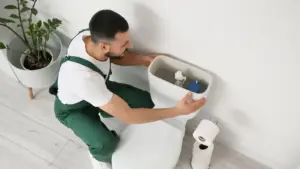
 A toilet that keeps running after flushing is more than an annoyance — it can waste 200 or more gallons of water per day, which adds up quickly on a Houston water bill. The good news is that most running toilet problems have straightforward causes that can be diagnosed and often fixed without calling a plumber.
Here’s a systematic guide from Santhoff Plumbing to help you diagnose a running toilet and know when it’s time to call us.
How to Diagnose a Running Toilet
Step 1: Remove the Tank Lid and Listen
Take off the toilet tank lid (the top of the back part of the toilet) and listen while the toilet runs. The two most common locations for the problem will become apparent:
- Water is going into the overflow tube — the tall vertical tube in the center of the tank. If water is spilling into it, your fill valve is filling the tank too high.
- Water is running out through the flapper — you’ll hear a slight hiss and may see water movement near the flapper at the bottom of the tank.
The Flapper: Cause of 85% of Running Toilets
The flapper is the rubber seal at the bottom of the tank that controls water release when you flush. When a flapper wears out, warps, or accumulates mineral buildup, it no longer seals completely, and water slowly leaks into the bowl continuously.
Test: Put a few drops of food coloring in the tank. Wait 15 minutes without flushing. If color appears in the bowl, the flapper is leaking.
Fix: Flappers are $8–$15 at any hardware store and take 10 minutes to replace. Turn off the water supply valve behind the toilet, flush to empty the tank, unhook the old flapper, and snap the new one in place.
Fill Valve Problems
If the flapper tests fine but the toilet still runs, the fill valve may be malfunctioning, either filling too slowly, shutting off at the wrong level, or not shutting off at all.
Fix the float height: If water is going into the overflow tube, the float (usually a ball or cup float) is set too high. Adjust the float down until the water level sits about 1 inch below the top of the overflow tube.
Replace the fill valve: If adjusting the float doesn’t help or the fill valve makes noise, replacement is the answer. A new fill valve costs $15–$25 and takes 30–45 minutes to install.
Toilet Flange and Base Issues
If your toilet rocks at the base, has water staining around it, or shows rust around the bolts, the wax ring seal may have failed. This is a toilet repair that requires removing and resetting the toilet, a job for Santhoff Plumbing.
When to Call Santhoff Plumbing for Toilet Repair
- The toilet rocks or feels unstable at the base
- Water is visible around the base of the toilet
- DIY flapper and fill valve replacement hasn’t fixed the running
- The toilet requires multiple flushes to fully clear
- You’re considering a toilet replacement with a newer, more efficient model
Frequently Asked Questions
How much does toilet repair cost in Houston?
Basic toilet repairs (flapper, fill valve) run $75–$150 for professional service. Wax ring replacement adds $150–$250. A full toilet replacement runs $250–$600, depending on the fixture.
Is a running toilet an emergency?
Not usually, but 200+ gallons of water waste per day adds up quickly on a Houston water bill. Most running toilet repairs are same-week non-emergency appointments.
How do I know if my toilet needs to be replaced vs. repaired?
Toilets over 25 years old with recurring problems, cracks in the porcelain, or outdated 3.5-gallon-per-flush designs are usually better replaced than repeatedly repaired. Modern 1.28-gallon toilets can significantly reduce water bills.
Can I use toilet tablets to clean the tank?
Blue tank tablets can damage rubber flappers over time by degrading the rubber. Use liquid toilet cleaner in the bowl instead, or use tablet cleaners that hang in the bowl rather than sitting in the tank.