

Quick Answer
Trenchless sewer repair fixes your line through two small access pits, typically costing $4,000–$12,000. Traditional dig-and-replace opens a full trench and runs $2,000–$10,000 in plumbing, but adds thousands in yard and driveway restoration. Trenchless usually wins when the line runs under concrete, mature trees, or landscaping.
Why This Matters in Houston
Sewer lines don’t fail politely. They fail on the day you’re hosting, in the lowest drain in the house, and they announce themselves with a smell you never forget.
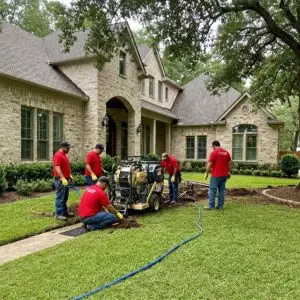
Houston makes this worse than most cities for three specific reasons:
- Expansive clay soil. Our gumbo clay swells when it rains and shrinks when it doesn’t. That constant movement shears joints, cracks pipe, and pulls lines out of alignment. It’s the same soil behavior that drives slab leaks across the region.
- Cast iron and clay tile. Homes built before the mid-1970s — the Heights, Montrose, West University, Garden Oaks, Oak Forest — are largely served by cast iron or clay pipe that has now outlived its design life. Cast iron corrodes from the inside until the bottom of the pipe simply isn’t there anymore.
- Aggressive tree roots. Live oaks and pecans hunt for moisture. A hairline crack in a sewer line is an invitation, and roots will follow it into the pipe and fill it.
The financial stakes are real. A sewage backup into a finished home is a biohazard remediation, not a cleanup. And the wrong repair method — a full trench through a mature yard when a trenchless option existed — can add five figures in restoration that you never needed to spend.
What Each Method Actually Involves
Traditional dig-and-replace
A crew locates the line, then excavates a trench along its entire path — through lawn, flowerbeds, sidewalk, driveway, whatever sits on top. The damaged pipe is removed and new PVC or cast iron is laid at the correct slope, backfilled, and compacted. Then the surface gets rebuilt.
It’s the oldest method and it’s still the right one in plenty of situations. It’s also the reason people picture a sewer repair as a backhoe and a canyon where the front yard used to be.
Trenchless: CIPP pipe lining
Cured-in-place pipe lining threads a resin-saturated liner into the existing pipe through an access point, inflates it against the interior walls, and cures it with steam or UV light. What you’re left with is a smooth, jointless pipe formed inside the old one — no joints for roots to exploit, no seams to shift.
CIPP has one hard requirement: the host pipe must still be structurally sound enough to line. It’s ideal for cracks, corrosion, and root intrusion in a pipe that’s degraded but intact.
Trenchless: pipe bursting
Pipe bursting digs two small pits — typically one at the cleanout, one near the street. A bursting head is pulled through the old line, fracturing it outward into the surrounding soil while simultaneously pulling new HDPE pipe into the void it creates.
Bursting handles worse conditions than lining. It works when the old pipe is heavily broken or root-choked, and it can upsize a line from 4″ to 6″ on the way through. It costs more, but it delivers a genuinely new pipe rather than a liner inside an old one.
Trenchless vs. Traditional: Pros, Cons, and Cost
Traditional dig-and-replace
Pros:
- Lowest cost per foot — generally $50–$125 per linear foot for the plumbing work itself.
- Works in every condition, including total collapse, severe bellies, and misalignment.
- Allows the crew to correct slope, which no trenchless method can fully do.
- Fully visible — the plumber can see and verify every foot.
Cons:
- Restoration is where the money hides. Sod runs a few dollars per square foot; a concrete driveway re-pour runs far more. Restoration alone can add thousands.
- Mature trees, irrigation systems, patios, and hardscape are frequently casualties.
- Typically 2–3 days of active work, plus restoration time.
Trenchless (lining or bursting)
Pros:
- Two small pits instead of a trench. Your driveway, your oak, and your patio survive.
- Faster: CIPP often cures in a single day; bursting typically finishes in one to two.
- A properly installed liner or HDPE pipe carries an expected service life of 50 years or more.
- Jointless construction eliminates the root entry points that caused the failure in the first place.
Cons:
- Higher cost per foot — roughly $60–$250 per linear foot depending on method and diameter.
- Not universally eligible. Collapsed pipe, severe bellies, and back-to-back bends can disqualify it.
- Lining slightly reduces internal diameter (immaterial for residential flow, but real).
- Requires specialized equipment and training — not every plumber offers it.
The cost comparison that actually matters
Per foot, trenchless looks more expensive. Total project cost is a different question. A typical Houston residential sewer replacement lands somewhere in the $4,000–$15,000 range depending on length, depth, and method — and the deciding variable usually isn’t the pipe. It’s what sits on top of it.
Here’s the rule of thumb we use: if the line runs under a driveway, patio, deck, mature trees, or significant landscaping, trenchless almost always wins on total cost. If it runs under plain grass with clear access and no obstacles, traditional dig-and-replace is usually cheaper and just as good.
Trenchless is not automatically the premium choice. It’s the choice that protects what’s above the pipe. When there’s nothing above the pipe worth protecting, you shouldn’t pay for it.
The Camera Inspection Settles It
Nobody — no plumber, no salesperson, no article — can tell you which method your home needs without seeing inside the pipe.
A sewer camera inspection runs a high-definition head down the line and shows exactly what’s happening: root intrusion, cracks, corrosion, offset joints, bellies, or collapse. That footage determines whether the pipe is a lining candidate, a bursting candidate, or an excavation job. It also distinguishes a spot repair from a full replacement — a distinction worth thousands of dollars.
Be direct with any contractor who quotes a method before running a camera. They are quoting the equipment already on their truck, not the repair your house needs. Our sewer repair team inspects first, then recommends — and shows you the footage.
Common Mistakes and Real Risks
- Repeatedly snaking a line instead of diagnosing it. Two mainline clearings in twelve months is not a clog problem. It’s a pipe problem, and the cable is buying time at the price of the eventual repair.
- Assuming trenchless is always better. Lining a pipe with a severe belly locks the low spot in place permanently. You’ve just paid to preserve the defect.
- Skipping the camera and permitting. Houston requires a plumbing permit for sewer work, and crossing into the public right-of-way requires additional permitting. Unpermitted sewer work surfaces at resale and can force you to redo it.
- Choosing on price alone. A bid that’s dramatically low usually excludes restoration, permits, cleanout installation, or right-of-way work. Ask for those line items explicitly.
- Ignoring the early warnings. Multiple slow drains at once, gurgling toilets, sewage odor in the yard, or a suspiciously green patch of grass over the line are all pre-failure signals. Addressing them costs a fraction of addressing a backup.
- Assuming insurance covers it. Standard homeowners policies generally treat sewer line deterioration as a maintenance issue, not a covered peril. Verify before you assume.
Which Method Is Right for Your Home?
Choose trenchless when: the line runs under concrete, hardscape, or mature landscaping; the host pipe is degraded but intact; you want minimal disruption; or you’re in a tight lot where a backhoe simply can’t maneuver.
Choose traditional when: the pipe has collapsed or has a severe belly requiring slope correction; the run is short, shallow, and under open lawn; or the camera reveals problems trenchless can’t address.
What happens if you choose wrong: lining a structurally unsound pipe produces a liner that fails with the host. Trenching a yard that didn’t need it means paying for a repair and a landscape rebuild. Both mistakes are expensive, and both are avoidable with one camera inspection.
If the camera shows failure along the entire run, you’re looking at full sewer line replacement regardless of method — and the conversation shifts to which approach protects your property best.
Why Choose Santhoff Plumbing
Experience. We’ve been repairing Houston sewer lines since 1974 — over 50 years, with more than 200 years of combined experience across our licensed team. We’ve worked under Heights bungalows, River Oaks estates, and Katy new builds, and we know how Houston’s clay soil behaves against buried pipe.
Reliability. Veteran-owned, family-operated, and rated 4.9 stars across 840+ Google reviews. We quote upfront, we show you the camera footage, and we back every job with a satisfaction guarantee. Sewer failures don’t respect business hours — our 24/7 emergency plumbers are dispatched day or night, and financing is available so a five-figure repair doesn’t have to be a five-figure shock.
Quality and technology. High-definition camera inspection, hydro-jetting, and licensed master plumbers who pull every required permit. The Santhoff Family Club ($20/month) includes a free annual safety inspection, front-of-line priority service, a reduced service fee, 10% off all services, and a 2-year warranty on most repairs — which is exactly how a $400 camera inspection prevents a $15,000 emergency.
Service area. We cover the greater Houston area, including Missouri City, Sugar Land, Katy, Memorial, Bellaire, West University, Montrose, and the Heights. Check our full service area.
Suspect a sewer problem? Call (713) 665-4997 or request service online. We’ll find out what’s actually wrong before anyone touches your yard.
Frequently Asked Questions
Is trenchless sewer repair always cheaper than digging?
No. Per linear foot, trenchless typically costs more. It wins on total cost when restoration is expensive — concrete driveways, patios, mature trees, irrigation. If your line runs under open lawn with easy access, traditional excavation is often the cheaper and equally sound choice.
Can trenchless repair fix a collapsed sewer line?
CIPP lining cannot — the liner needs a path through the pipe. Pipe bursting can often handle heavily damaged lines, because it fractures the old pipe outward as it pulls new pipe through. A fully collapsed line with no path at all generally requires excavation. The camera inspection determines which applies.
How long does a trenchless sewer repair last?
A properly installed CIPP liner or HDPE pipe is engineered for 50+ years. That comfortably exceeds the lifespan of the cast iron and clay tile it typically replaces — materials designed for 50 to 75 years and now failing across Houston’s older neighborhoods.
What are the warning signs I need sewer work at all?
Multiple fixtures draining slowly at the same time, gurgling from toilets when the washer drains, sewage odor indoors or in the yard, unusually lush grass over the sewer path, or recurring backups. Any of these warrants a camera inspection before it becomes an emergency.
Do I need a permit for sewer line work in Houston?
Yes. Sewer repair and replacement require a City of Houston plumbing permit, pulled by a licensed plumber, and work crossing into the public right-of-way requires additional permitting. We handle the paperwork and the inspection scheduling — you shouldn’t have to chase it.
How disruptive is the work to my daily life?
CIPP lining is often a same-day job with two small pits. Pipe bursting typically takes one to two days. Traditional excavation runs two to three days of active work plus restoration. In all three cases, expect limited water use during the work itself — we’ll tell you exactly when.