

Quick Answer
Choose tankless if you plan to stay 7+ years, want endless hot water, and can accommodate gas and venting upgrades. Choose a tank if you need a fast, lower-cost replacement or your gas line won’t support on-demand heating. Houston’s hard water shortens tank life to 7–10 years, which changes the math.
Why This Matters More in Houston Than Almost Anywhere Else
Most water heater comparisons are written for a generic American house. Houston isn’t one. Three local realities change the answer:
- Hard water. Greater Houston’s municipal supply runs mineral-heavy. Scale builds inside tanks and inside tankless heat exchangers, and it does not care what the brochure promised.
- Warm inlet water. Groundwater entering your home in Houston is significantly warmer than in Chicago or Denver. A tankless unit has less work to do to hit 120°F, so it delivers higher usable flow here than its rated specs suggest in colder markets.
- Housing stock. A 1950s bungalow in the Heights and a 2019 build in Katy present completely different gas, venting, and electrical conditions. The same unit can cost $4,000 in one and $8,000 in the other.
Get this decision wrong and you’re not just out money — you’re living with lukewarm showers, an undersized unit that short-cycles, or a tank that fails prematurely and floods a garage. Get it right and you buy 15 to 20 years of not thinking about hot water at all.
How Each System Actually Works
Tank (storage) water heaters
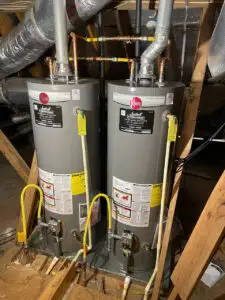
A tank heater holds 40 to 75 gallons at temperature around the clock. When you open a hot tap, heated water leaves the top and cold water enters the bottom. The burner or element fires to bring it back up. That constant reheating of water nobody is using is called standby loss, and it’s on your gas bill every month whether you’re home or on vacation.
Tanks are simple, cheap to install, and forgiving. They’re also a race against corrosion: a sacrificial anode rod inside the tank slowly dissolves to protect the steel liner. When the anode is gone, the tank starts rusting from the inside, and the failure mode is a puddle on your floor.
Tankless (on-demand) water heaters
A tankless unit sits idle until you call for hot water. Flow triggers ignition, and water passes through a heat exchanger that raises its temperature on the way to the fixture. There is no reservoir, so there is nothing to run out and nothing to lose heat overnight.
The trade-off is that tankless heaters are rated in gallons per minute (GPM), not gallons of storage. A properly sized whole-home gas unit in Houston typically delivers 7–9 GPM — enough for two showers and a dishwasher simultaneously. Undersize it and you’ll get a cold sandwich: hot, then cold, then hot again as demand outruns capacity. Our team sizes every tankless water heater installation against your actual fixture count, not a rule of thumb.
Tankless vs. Tank: The Honest Comparison
- Installed cost. A straight tank-for-tank swap in Houston generally runs $1,800–$3,500 installed. A tank-to-tankless conversion typically runs $4,200–$8,000, because it isn’t an appliance swap — it’s a system upgrade.
- Lifespan. Tanks last 8–12 years nationally, but Houston’s hard water realistically pulls that to 7–10. Tankless units last 15–20 years, and 20+ with annual descaling.
- Operating cost. Tankless eliminates standby loss entirely, generally cutting water-heating energy use meaningfully for average households. The savings are real but gradual — they don’t repay a conversion in two years.
- Hot water supply. A 50-gallon tank gives you roughly two back-to-back showers before recovery. Tankless is continuous, indefinitely.
- Space. A tank eats a 2×2 footprint in a garage or closet. A tankless unit is wall-mounted, roughly the size of a carry-on suitcase, and can go on an exterior wall.
- Failure mode. A tank fails wet — 50 gallons on the floor. A tankless unit fails dry: it stops making hot water, but it doesn’t flood your garage.
- Infrastructure demands. Gas tankless usually requires a 3/4″ gas line (many Houston homes have 1/2″), new stainless venting, and a dedicated electrical circuit for controls and ignition.
That last bullet is where budgets break. If your home already has adequate gas supply and a convenient exterior wall, you land near the bottom of the tankless range. If a plumber has to run a new gas line from the meter across a slab-foundation home and cut new venting, you land near the top. Any honest quote separates the unit from the infrastructure. If a bid doesn’t, ask why.
Houston’s Hard Water Changes the Math
Scale is the silent variable nobody mentions until the warranty claim.
In a tank, minerals settle to the bottom and form an insulating crust between the burner and the water. The burner runs longer to hit the same setpoint, the steel overheats, and the tank fails early. That popping and rumbling you hear from an older tank is water flashing to steam under the sediment layer.
In a tankless unit, scale coats the narrow passages of the heat exchanger — the exact surfaces that make the technology work. Flow rate drops, error codes appear, and an unmaintained tankless system in Houston can lose years off its life.
The fix isn’t complicated: annual descaling, and ideally, treating the water before it ever reaches the unit. A whole-home water treatment system protects the heater, the fixtures, and the appliances downstream of it. If you’re going tankless in Houston, treat descaling as part of ownership, not an upsell.
Common Mistakes and What They Cost
- Buying tankless for a house you’re selling in two years. The payback horizon is 7–12 years. If you’re moving sooner, you’re subsidizing the next owner.
- Sizing on price instead of GPM. An undersized unit is worse than the tank it replaced — you paid more for a colder shower.
- Skipping the permit. The City of Houston requires a plumbing permit for water heater installation, pulled by a licensed plumber. Unpermitted work surfaces at resale, fails inspection, and can void the manufacturer’s warranty.
- Ignoring the gas line. A tankless unit starved of gas will run, but it will underperform and eventually fault. Adequate supply isn’t optional. Our gas line plumbing crew sizes the supply before we commit to a unit.
- Never flushing anything. An untouched tank in Houston can lose a third of its efficiency to sediment. An untouched tankless unit will eventually throw a flow-rate error and quit.
- DIY installation. Improper vent termination on a gas unit is a carbon monoxide risk, not a code technicality.
When to Choose Which
Go tankless if:
- You’re staying in the home 7+ years.
- Your household regularly runs out of hot water — teenagers, guest suites, a soaking tub.
- You’re already remodeling and walls are open, which slashes the cost of gas and venting work.
- You want your garage or utility closet back.
- You’re willing to descale annually.
Stay with a tank if:
- Your heater just failed and you need hot water today — a tank swap is same-day, a conversion usually isn’t.
- Your budget is fixed and tight.
- Hot water demand is modest and predictable.
- You’re in a rental or investment property where upfront cost governs.
- Your gas service genuinely can’t support on-demand heating without a costly rebuild.
What happens if you get it wrong: an undersized tankless unit means cold sandwiches and a warranty fight. An oversized tank means you’re paying to heat water you never use. A conversion done without a gas upgrade means chronic underperformance the manufacturer won’t cover.
Two Houston Scenarios You’ll Recognize
The Bellaire family of five. Two teenagers, three bathrooms, and a 50-gallon tank that surrenders by the third shower. This is the textbook tankless case — the pain is capacity, not cost. A properly sized gas unit ends the morning negotiation permanently.
The Sugar Land empty nesters. Two people, one shower a day, and a 12-year-old tank that just started weeping at the base. Tankless would work fine, but it solves a problem they don’t have. A quality 50-gallon replacement, installed correctly with a new expansion tank, is the better use of their money.
The right answer is the one that matches your household — not the one with the better marketing.
Why Choose Santhoff Plumbing
Experience. We’ve been a Houston plumbing company since 1974 — over 50 years, and more than 200 years of combined experience across our licensed team. We’ve installed both technologies in every kind of Houston home, from pre-war bungalows to new construction, and we’ll tell you when tankless isn’t worth it.
Reliability. Veteran-owned and family-operated, with a 4.9-star rating across 840+ Google reviews and a satisfaction guarantee on every job. When a heater fails at 11 p.m., our 24/7 emergency plumbers answer. We quote upfront, and financing is available so a failed heater doesn’t become a financial emergency.
Quality and technology. Every installation is permitted, code-compliant, and performed by licensed plumbers. Members of the Santhoff Family Club — $20 per month — get a free annual safety inspection, front-of-line priority service, a reduced service fee, 10% off all services, a 2-year warranty on most repairs, and an extended 10-year warranty on both conventional and tankless water heaters. In a hard-water city, that warranty is not a small thing.
Service area. We cover the greater Houston area, including the Heights, Montrose, River Oaks, West University, Bellaire, Memorial, Katy, Sugar Land, and Missouri City. See the full list of areas we serve.
Ready to decide? Call (713) 665-4997 or request service online, and we’ll size the right system for your home before you spend a dollar.
Frequently Asked Questions
Can I put a tankless water heater where my old tank was?
Usually, yes — provided there’s adequate combustion air and correct venting. Tankless units are wall-mounted and take far less space, so the old closet or garage location often works. Some Houston homes actually benefit from relocating the unit to an exterior wall, which simplifies venting and reduces cost.
How often does a tankless water heater need descaling in Houston?
Annually, at minimum. Houston’s hard water makes this non-negotiable. Skipping descaling reduces flow rate, triggers error codes, shortens the unit’s life, and can jeopardize warranty coverage. Many manufacturers require documented maintenance to honor a claim.
Will a tankless water heater lower my gas bill immediately?
You’ll see a reduction from eliminating standby loss, but it’s a monthly trickle, not a windfall. Tankless is a long-horizon investment: the return comes from lower operating cost and a lifespan roughly double a tank’s. If you’re chasing a fast payback, tankless isn’t the right lever.
How long does installation take?
A like-for-like tank replacement is typically a 2–4 hour job, often same-day. A tank-to-tankless conversion usually runs 6–10 hours and may require a permit inspection, because it involves gas line work, new venting, and electrical connections.
Do I need a water softener if I go tankless?
You don’t strictly need one, but in Houston it’s the single best thing you can do to protect the investment. Treating the water upstream reduces scale in the heat exchanger, extends unit life, and protects faucets, fixtures, and appliances at the same time.
My tank is 10 years old but still working. Should I replace it now?
A 10-year-old tank in Houston is on borrowed time. Replacing it on your schedule costs the same as replacing it on an emergency schedule — minus the water damage, the after-hours rate, and the day without hot water. If you see rust at the base, hear rumbling, or notice slower recovery, plan the replacement now.